Hybrid Poplar & 'Miracle' Fast-Growing Trees (Skip It) review: skip it
The mail-order ads promising instant privacy from a miracle tree are describing hybrid poplar honestly and its consequences not at all: yes it grows shockingly fast, and that speed is bought with weak wood, invasive roots, disease problems and a short, messy life. Fast is the tree's whole résumé, and fast is a flaw wearing a benefit's clothes.
What we like
- The growth-rate claims are broadly true — establishment really is startlingly quick
- Legitimate uses exist: windbreaks on acreage, biomass planting, temporary screening far from structures
- Cheap and nearly foolproof to root, which is why catalogs love selling it
Flaws but not dealbreakers
- Fast growth means weak, brittle wood — storm damage is a matter of when
- Aggressive, moisture-seeking roots menace foundations, sewer lines, septic fields and lawns
- Short-lived and disease-prone; the privacy screen begins declining just as you rely on it
- Constant litter — dropped branches, suckers, seasonal mess — for its whole abbreviated life
- Removal of a large declining poplar costs far more than the tree ever did
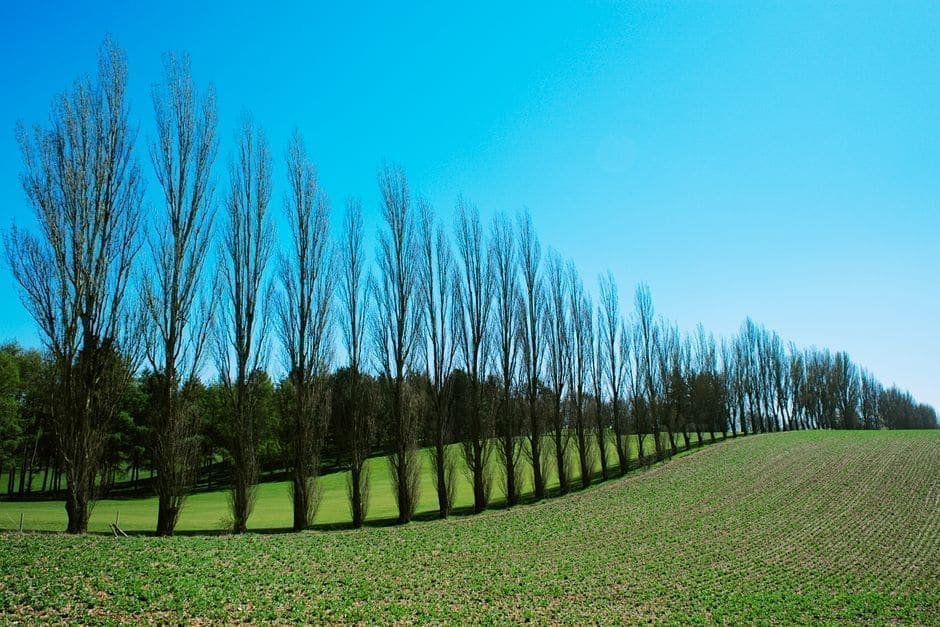
Every spring the same advertisement blooms across the back pages and banner slots of the internet: a towering wall of green, a family in its shade, and a promise that this miracle tree grows several feet a year. The tree is usually a hybrid poplar or one of its fast-growing cousins, and here's the uncomfortable part — the headline claim is true. These trees really do grow with cartoon speed. The advertisement simply ends before the biology does. What follows is the rest of the story, assembled from what arborists and extension services have been saying about these trees for decades.
In trees, speed is a trade, not a gift. Wood laid down fast is wood laid down weak, and hybrid poplar's brittle branching is notorious among arborists for shedding limbs in the storms every region eventually hosts — the mature specimen near your driveway is less a shade tree than a scheduled insurance conversation. The same metabolic hurry shortens the lifespan: these are decades-not-generations trees that begin declining right around the time an anxious homeowner has finally gotten the privacy screen they planted it for, and a big dying poplar must then be removed at a cost that dwarfs the original bargain many times over. Budget for the removal on the day you plant one, because you are planting the removal too.
See where this lands against the field in High Country Gardens.
Below ground it gets worse. A tree that grows that fast is drinking accordingly, and poplar roots are famous moisture-hunters — shallow, wide-ranging, and drawn to the water in sewer laterals, septic fields, irrigation lines and foundation perimeters. Add the suckering habit, where new shoots erupt from roots across the lawn and into the neighbor's, and the miracle tree reveals itself as a long-term relationship with your least favorite contractors. None of this is obscure: extension services have been writing the same warning for as long as the catalogs have been running the same ad. If a tree salesman's best argument is speed, the roots are where you should look first.
The legitimate uses deserve their acre — literally. On rural land, planted far from structures and lines, hybrid poplars make defensible windbreaks and quick temporary screening while slower, better trees mature behind them; they're also grown deliberately as biomass. That's the context the species was hybridized for, and in it the vices are manageable. A suburban lot is the opposite of that context in every dimension that matters: the property lines are closer, the pipes are everywhere, and the falling limb has somewhere expensive to land.
If the actual goal is privacy on a residential timeline, the boring honest answer is a fast-enough tree instead of a fast one: arborvitae varieties, hollies, junipers and other dense evergreens suited to your hardiness zone establish a real screen only somewhat later and then stand healthy for a lifetime, dropping neither limbs nor property value. Buy the screen you'll still be glad of in twenty years — the miracle tree's entire pitch is that you won't think about twenty years, and it's the only part of the ad that's aimed at you rather than the tree.
Key specs
- Type
- Category review — hybrid poplar and similar 'instant shade' trees
- Our position
- Acreage windbreaks only; never near homes, pipes or property lines